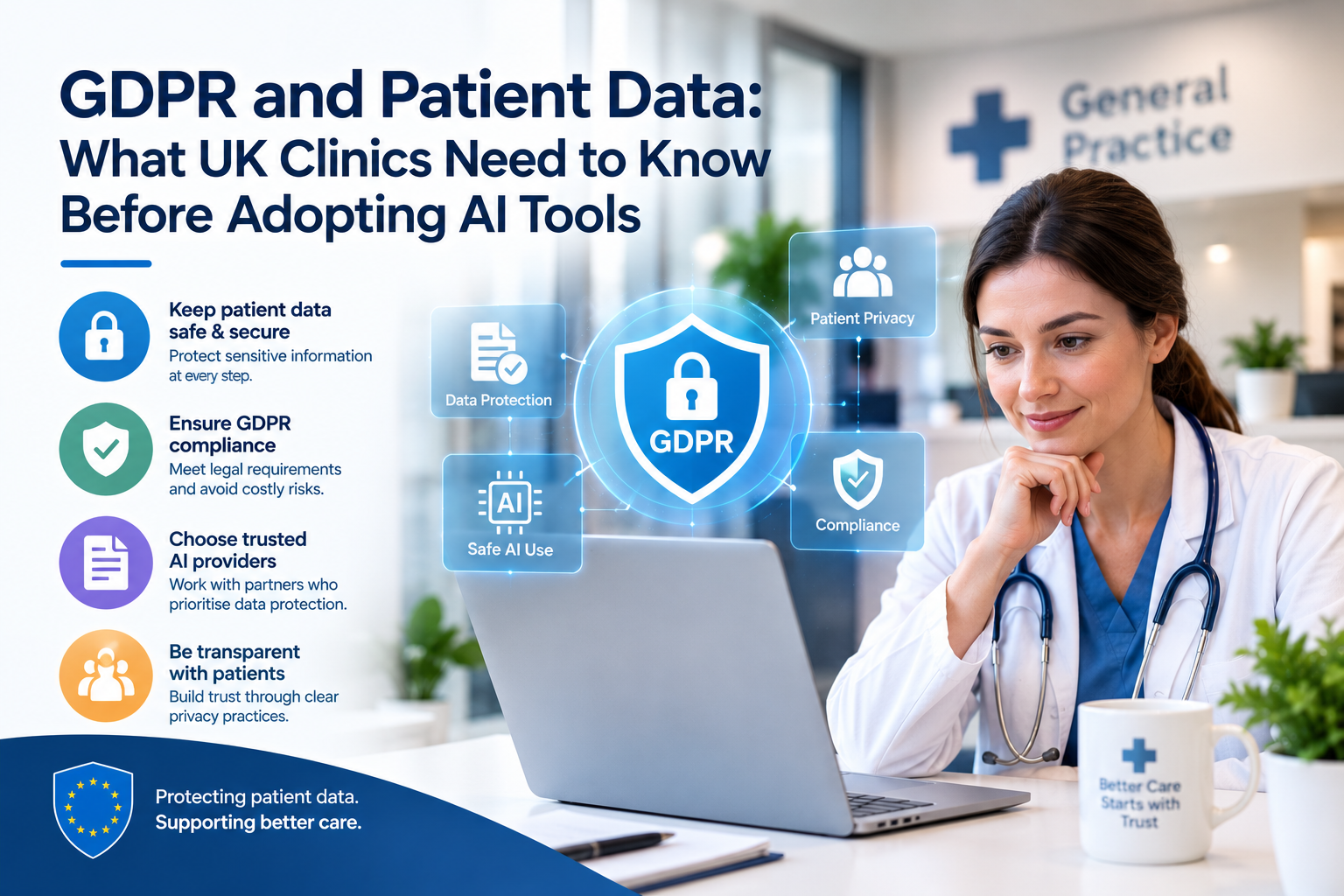
AI Data Protection in Healthcare is an important consideration for any clinic adopting an AI receptionist, chatbot, or voice AI system. Any AI tool that handles patient names, contact details, or appointment history is processing personal data — and in a clinical setting, some health-related information may qualify as special category data under UK GDPR.
Before adopting an AI receptionist for healthcare or healthcare chatbot, clinics should ask specific, concrete questions rather than accepting a general assurance that a vendor is “compliant.”
AI Data Protection in Healthcare: Where Is Patient Data Stored?
Ask whether patient data is stored on UK or EU servers, and what happens if the vendor uses a US-based cloud provider. The location and transfer of personal data can affect a clinic’s obligations under UK data protection law.
A responsible healthcare AI vendor should be able to explain clearly where data is hosted, which providers are involved, and whether international data transfers take place.
Where Is AI Patient Data Hosted?
Clinics should understand exactly where patient data processed by an AI receptionist or chatbot is stored and whether third-party infrastructure providers are involved.
This should be documented clearly rather than explained through vague statements about security or compliance.
Who Can Access Patient Data and How Long Is It Retained?
Clinics should know exactly how long AI call transcripts, booking data, and any recorded audio are retained, who at the vendor’s company can access them, and what the deletion process looks like.
AI Call Recording and Data Retention
If a voice AI receptionist records calls, ask:
- Are calls recorded and stored?
- How long are recordings retained?
- Who can access recordings and transcripts?
- Can data be deleted when required?
- Are recordings used for AI model training?
- Is the patient informed about recording and relevant data processing?
Understanding AI data retention is an essential part of evaluating any system that handles patient information.
Does the AI Vendor Provide a Data Processing Agreement (DPA)?
A Data Processing Agreement (DPA) is an important part of due diligence when a third-party AI vendor processes personal data on behalf of a clinic.
Clinics should request the vendor’s DPA and review what it covers, including the processing activities, security measures, subprocessors, data retention, and deletion arrangements.
A vendor that cannot provide appropriate data-processing documentation should be treated as a potential red flag.
Why a DPA Matters for Healthcare AI
An AI receptionist for clinics may interact with patients and process information on the clinic’s behalf. The clinic therefore needs to understand its relationship with the AI provider and the provider’s responsibilities for handling personal data.
What Happens to Voice Recordings?
For clinics using Voice AI for Healthcare, voice recordings require particular attention. Ask whether calls are recorded, whether callers are informed, how recordings are stored, and whether the data is used for purposes such as improving or training AI models.
Voice AI and Patient Privacy
Clinics should understand the vendor’s approach to voice recordings, call transcripts, patient privacy, and AI training data before deploying a voice AI system.
The precise requirements can depend on how the system operates and what information is processed, so clinics should obtain clear documentation from the vendor and take appropriate professional data-protection advice where necessary.
AI Data Protection in Healthcare: Practical Due Diligence
Before signing with an AI healthcare vendor, request the following information in writing:
- Data Processing Agreement (DPA)
- Data hosting and storage locations
- Data retention policy
- Data deletion procedures
- Subprocessor information
- Call recording and transcription policies
- AI model training and data-use policies
- Security and access-control information
This is not excessive caution. It is a practical baseline for any clinic evaluating technology that handles patient information.
Adopting AI tools does not have to mean compromising on data protection, but it does mean asking the same rigorous questions you would ask of any other supplier handling sensitive information. A well-designed AI receptionist for healthcare should fit into the clinic’s wider data-protection processes rather than operating outside them.